In boardrooms and factory floors alike, artificial intelligence has moved from futuristic promise to everyday reality. Companies are investing heavily, tools are proliferating, and expectations are high. Yet for many manufacturers, the return on that investment remains frustratingly elusive.
The pattern is now well documented. According to McKinsey’s 2025 Global Survey On the State of AI, 88 percent of organizations report regular AI use in at least one business function. But nearly two-thirds have yet to scale these efforts across the enterprise.
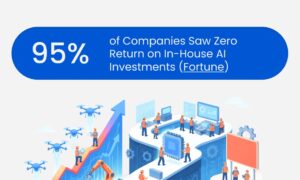
A separate MIT NANDA initiative report, “The GenAI Divide,” paints an even sharper picture: just 5 percent of AI pilot programs achieve rapid revenue acceleration. The other 95 percent stall, delivering little or no measurable impact on the profit and loss statement.
What these numbers reveal is not a failure of the technology itself, but a deeper shortfall in organizational readiness. In manufacturing, with its complex supply chains, legacy equipment, stringent quality requirements, and blend of skilled trades and knowledge of work, this gap is particularly consequential. A sleek generative AI tool can draft reports or optimise a schedule, but it cannot magically overcome fragmented data systems, underprepared teams, or strategies that remain vague.
Without a clear-eyed assessment of where a business truly stands, even substantial investments yield pilots that never scale and technologies that never move the needle on cost, quality, or output.
Bridging the Gap with Structured AI Readiness
The MIT research underscores a key lesson: success is less about building tools from scratch and more about smart integration. Purchasing specialized solutions and forming partnerships succeeds roughly twice as often as internal development efforts. Empowering line managers closest to the work, rather than relying solely on central innovation teams, also makes a decisive difference.
For manufacturers, these insights carry extra weight. AI’s greatest potential often lies in tightly intertwined areas, predictive maintenance on the shop floor, quality inspection, supply chain optimization, and process redesign. But these applications demand more than a powerful model. They require reliable data infrastructure, deep operational knowledge, workforce capability, and strategic clarity. When those foundations are missing, even cutting-edge tools remain isolated from experiments.
The Human and Operational Reality
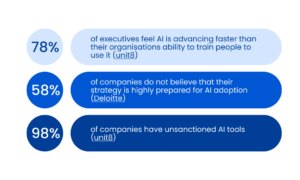
The challenges run deeper than software licenses. A 2024 survey found that 78 percent of executives feel AI is advancing faster than their organizations’ ability to train people to use it. And, the data confirms this. According to Deloitte, 58% of companies do not believe that their strategy is highly prepared for AI adoption and even fewer say the same about risk and governance
Meanwhile, “shadow AI”, unsanctioned tools employees use on their own, is nearly universal, appearing in 98 percent of organizations. Workers are adopting AI regardless of official policy, and companies are missing the opportunity to guide that energy productively while protecting sensitive operational data.
The Path Forward for Manufacturers
This is precisely the problem the AI Maturity and Readiness Index (AIMRI) is built to address. Rather than another technology deployment, AIMRI provides manufacturers with a structured, objective diagnostic across the dimensions that matter most: data infrastructure, operational integration, workforce capability, and strategic alignment.
By establishing a clear baseline, AIMRI helps leaders answer the questions that determine whether AI will deliver value or simply add to the growing list of stalled initiatives: Where does our organization actually stand on the maturity curve? What specific gaps are holding us back? And what targeted changes will enable scalable, measurable progress?
The story of AI in manufacturing in 2026 is not ultimately about adoption rates or model sophistication. It is about whether companies understand their own capabilities well enough to integrate technology into the realities of industrial operations. Those that do, by diagnosing readiness honestly, addressing workforce concerns, redesigning workflows thoughtfully, and investing where it counts, are the ones turning pilots into performance gains.
Technology is no longer the limiter. Readiness is. And, for manufacturers determined to cross the divide between experimentation and real competitive advantage, a rigorous understanding of their current state is the essential starting point.