
Introduction
There is a particular kind of frustration that rarely makes the news. It lives inside ministries of industry, economic planning agencies, investment promotion bodies, and public institutions responsible for national competitiveness. Governments commit to ambitious industrial strategies. Budgets are approved. Policy documents are published. Terms such as Industry 4.0, AI readiness, sustainability, digital sovereignty, and industrial resilience appear in nearly every national roadmap.
Yet when the most important question is asked – where do our industries actually stand today? – the answer is often uncertain.
This uncertainty is not a failure of ambition. Many governments have the will to transform. They have programmes, incentives, training schemes, industrial corridors, sustainability targets, and technology missions. What they often lack is a precise, objective, and comparable way to see whether these efforts are working, where they are working, for whom they are working, and — most critically — where they are quietly failing to reach the industries that need them most.
CivicHorizon is designed to close exactly that gap.
Designing Future-Proof Industrial Policies with Real Data
CivicHorizon, powered by INCIT, is a data-driven policy architecture that helps governments move from broad industrial intent to targeted, measurable action. It transforms real-world industrial data into structured policy intelligence, enabling decision-makers to diagnose performance, identify priority interventions, allocate resources with greater confidence, and track progress over time.
At its core, CivicHorizon is built around two deceptively simple questions:
- How do we move industries forward?
- How do we prevent decline before it becomes visible?
The second question is the harder one. Industrial decline rarely announces itself dramatically. It accumulates quietly in productivity levels that drift downward, in workforce capabilities that fail to keep pace with technology, in digital maturity gaps that widen while policy narratives continue to suggest progress, and in sustainability pressures that remain unmanaged until they become compliance risks or market-access barriers.
By the time these challenges surface at a national level, the window for effective intervention may already have narrowed. CivicHorizon helps governments act earlier and more precisely.
From Fragmented Signals to a Unified Industrial View
Traditional industrial policy depends on fragmented information: surveys, sectoral reports, anecdotal feedback, outdated statistics, and self-reported progress from companies. These inputs can be useful, but they rarely provide a complete or comparable picture of industrial readiness. They describe the past, not the present and certainly not the trajectory.
CivicHorizon changes this by integrating INCIT’s four Prioritisation Indexes into one coherent government intelligence layer:
- OPERI — operational excellence and productivity readiness
- SIRI — digital transformation and Industry 4.0 maturity
- AIMRI — artificial intelligence maturity and readiness
- COSIRI — sustainability, ESG, and net-zero readiness
Together, these frameworks allow governments to see industrial transformation not as a single technology agenda, but as a connected system — one where productivity, digital maturity, AI capability, workforce development, sustainability, and competitiveness are understood in relation to one another.
This matters because transformation does not happen in isolated silos. A country cannot build AI leadership without reliable data infrastructure. It cannot accelerate digitalisation without operational discipline. It cannot achieve sustainable manufacturing without visibility into resource performance.
CivicHorizon brings these signals together into what it calls a Micro-to-Macro approach: high-fidelity data from individual factories and firms, converted into national policy intelligence.
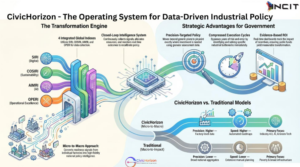
Figure 1. CivicHorizon as an operating system for data-driven industrial policy, integrating OPERI, SIRI, AIMRI, and COSIRI into a micro-to-macro transformation engine.
Turning Assessments into Policy Architecture
At INCIT, the focus is not on making grand claims about transformation.
Industrial development is slow, specific, and deeply contextual work. It resists shortcuts. What INCIT has built through years of assessment activity across manufacturing sectors and geographies is not a shortcut but it is a more disciplined way of seeing the challenge.
The value of standardised assessment is not simply that it produces a score. Its value lies in making industrial reality visible, comparable, and actionable. Without visibility, even well-intentioned policy becomes guesswork.
CivicHorizon takes assessment data and converts it into policy architecture. It translates the distance between an industry’s current state and its required future state into interventions that can be prioritised, sequenced, funded, and monitored. For governments, this creates a fundamental shift in how questions are asked:
From “What programmes should we launch?” to “Which sectors need which interventions, in what sequence, and with what expected impact?”
That shift is crucial. Without prioritisation, industrial policy risks becoming a catalogue of activities as programmes launched, money spent, reports published. With prioritisation, it becomes a decision system. A structured method for directing limited resources toward maximum impact.
The 12 States of Industrial Evolution
A central insight behind CivicHorizon is that industries do not all move in the same way. Across sectors and geographies, industrial systems tend to occupy different states of readiness, momentum, and risk.
Some are stagnant. Some are active but not progressing. Some are investing heavily but without the structural foundations required to convert investment into productivity. Some are quietly declining despite positive public narratives. Others are beginning to compound progress because they have sequenced transformation correctly.
The 12-state industrial evolution model helps governments understand this movement. It maps industries from early-stage inertia through fragile middle positions and into higher states of competitiveness, resilience, and self-renewal. At one end are systems trapped in stagnation or chaotic activity. At the other are industries capable of continuous renewal, where each improvement creates the conditions for the next.
This model is important because it prevents one-size-fits-all policymaking.
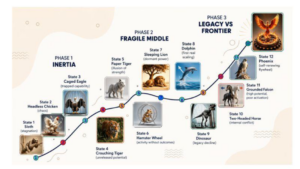
Figure 2. The 12-state industrial evolution curve, moving from inertia through fragile middle states toward legacy frontier and self-renewing industrial capability.
Matching Policy Instruments to Industrial Reality
CivicHorizon allows governments to locate industries on this evolution curve and design policy accordingly. Three broad tiers of intervention emerge:
Foundation. At the lower end of the maturity curve, the priority is foundational: skills development, digital access, basic productivity improvement, operational discipline, and awareness-building. These are the conditions that allow firms and workers to begin the transformation journey.
Alignment. At middle stages, policy must focus on removing bottlenecks: targeted advisory support, technology adoption incentives, capability-building programmes, sectoral benchmarking, and structured roadmaps that help firms move from fragmented initiatives to integrated transformation.
Acceleration. At the higher end, interventions become accelerative: research partnerships, export-readiness support, AI innovation programmes, advanced manufacturing grants, sustainability incentives, and performance-linked support that converts existing capability into global competitive advantage.
In this way, CivicHorizon ensures that policy is not merely distributed but it is directed. Resources flow to where the data shows they can create impact, not simply where the loudest lobby, strongest headline, or most visible crisis points.
A Living Feedback Loop, Not a One-Time Diagnosis
Better measurement does not automatically guarantee better outcomes. But it makes denial more difficult. When assessment data is objective, standardised, and grounded in real-world evidence, the comfortable fiction of “transformation in progress” becomes harder to sustain.
CivicHorizon is designed as an ongoing feedback loop rather than a one-time diagnostic exercise. Measurement informs intervention. Intervention changes performance. Changed performance is measured again. The cycle is continuous, not episodic.
The flow map groups states into three macro tiers: the Foundation Tier for low-maturity systems, the Alignment Tier for medium-maturity systems, and the Frontier Tier for high-maturity systems. Each tier requires a different kind of policy response, and each corridor carries a different probability of transition depending on readiness, sequencing, and the strength of intervention.

Figure 3. State transition flow map showing validated policy corridors across the Foundation, Alignment, and Frontier tiers, including the example target corridor from State 7 to State 8 to State 12.
Policy stays current as industrial reality changes. This is where CivicHorizon becomes more than an analytics tool — it becomes an operating system for data-driven industrial policy.
How Transition Corridors Improve Policy Design
The transition corridors add a dynamic layer to CivicHorizon. Instead of only describing where an industry is today, they help governments understand the most credible next move. For example, a State 1 “Sloth” system in the Foundation Tier may have a low but important probability of moving toward State 2 or State 3 unless basic capability, infrastructure, and institutional support are strengthened. A State 3 “Caged Eagle” system has a clearer path toward State 4 when foundational constraints are removed and latent capability is unlocked.
In the Alignment Tier, the map shows how middle-stage systems can either stall or accelerate. A State 7 “Sleeping Lion” may have a measured pathway toward State 8 through scaling support, but the a country-target corridor from State 7 to State 12 demonstrates the possibility of a more ambitious leap when policy combines maturity diagnostics, targeted incentives, capability building, and strong execution discipline. This is where CivicHorizon helps governments distinguish between incremental improvement and strategic acceleration.
In the Frontier Tier, transition corridors focus on protecting and renewing advantage. A State 9 “Dinosaur” may move toward State 10 or State 11 if legacy decline is addressed early, while a State 11 “Grounded Falcon” has a pathway toward State 12 “Phoenix” when high potential is converted into continuous renewal. This matters because advanced industries can also decline if their capabilities are not refreshed.
For policymakers, these corridors make intervention sequencing more precise. They clarify which states require rescue, which require alignment, which require acceleration, and which require renewal. They also create a basis for monitoring policy effectiveness: if an intervention is working, the industry should begin to move along a validated corridor; if it is not, the corridor signals where assumptions need to be corrected.
This is the practical value of CivicHorizon: it does not only identify maturity levels. It helps governments understand movement, probability, timing, and the policy conditions required to shift industries from one state to the next.
Why This Matters for Governments
For governments, the challenge is no longer simply to announce transformation. The challenge is to govern transformation intelligently.
That means knowing which sectors are ready to accelerate, which are at risk of falling behind, which regions need foundational support, which skills gaps are blocking progress, which incentives are producing results, and which interventions need to be redesigned.
CivicHorizon provides this clarity at every level of the industrial system:
- At the enterprise level, it identifies where individual companies stand and what they need next.
- At the cluster level, it reveals shared capability gaps that no single firm can address alone.
- At the sector level, it helps prioritise investment, reform, and sequencing.
- At the national level, it helps governments build a more resilient and competitive industrial base grounded in evidence, not aspiration.
This micro-to-macro visibility is essential because national competitiveness is not built in boardrooms or policy documents. It is built from the readiness of thousands of enterprises, workers, suppliers, and institutions. Without a structured way to connect these layers, governments risk flying blind in an era that demands precision.
The Self-Reinforcing Logic of Transformation
The countries and industries that benefit most from CivicHorizon are often not those already at the top, but those one level below where they need to be.
They are close enough to see the next stage, but not yet strong enough to reach it without deliberate support. They may have ambition, partial capability, and market opportunity, but lack the sequencing, incentives, or confidence to move decisively.
A manufacturer that understands its maturity position has a reason to improve it. A workforce that can see which skills attract future investment has a reason to acquire them. A government that can identify which sectors are ready for which interventions gain the confidence to allocate resources more wisely.
Over time, this creates a self-reinforcing loop. Measurement informs action. Action improves performance. Improved performance unlocks new opportunities. New opportunities attract investment. Investment strengthens capability. Capability drives competitiveness.
This is not utopianism. It is disciplined transformation logic.
From Industrial Blind Spots to Policy Blueprints
Industrial policy can no longer afford to rely on assumptions. In an era shaped by technological disruption, AI acceleration, sustainability pressures, supply-chain restructuring, and global competitiveness, governments need sharper instruments.
They need to know not only where they want their industries to go, but where those industries are starting from.
CivicHorizon helps governments move from blind spots to blueprints. It converts fragmented industrial signals into a structured decision system. It allows policymakers to diagnose, prioritise, intervene, and monitor with greater precision. It helps align incentives, workforce development, digital transformation, AI readiness, sustainability, and productivity within one integrated policy architecture.
For those shaping industrial strategy, economic development, sustainability policy, or AI investment, the question is no longer whether transformation is necessary. The question is whether governments can see clearly enough to know where to begin – and whether they can act early enough to shape the future before decline becomes visible.
That is the promise of CivicHorizon: not more policy noise, not another dashboard, but a clearer way to see, decide, and move industries forward.


