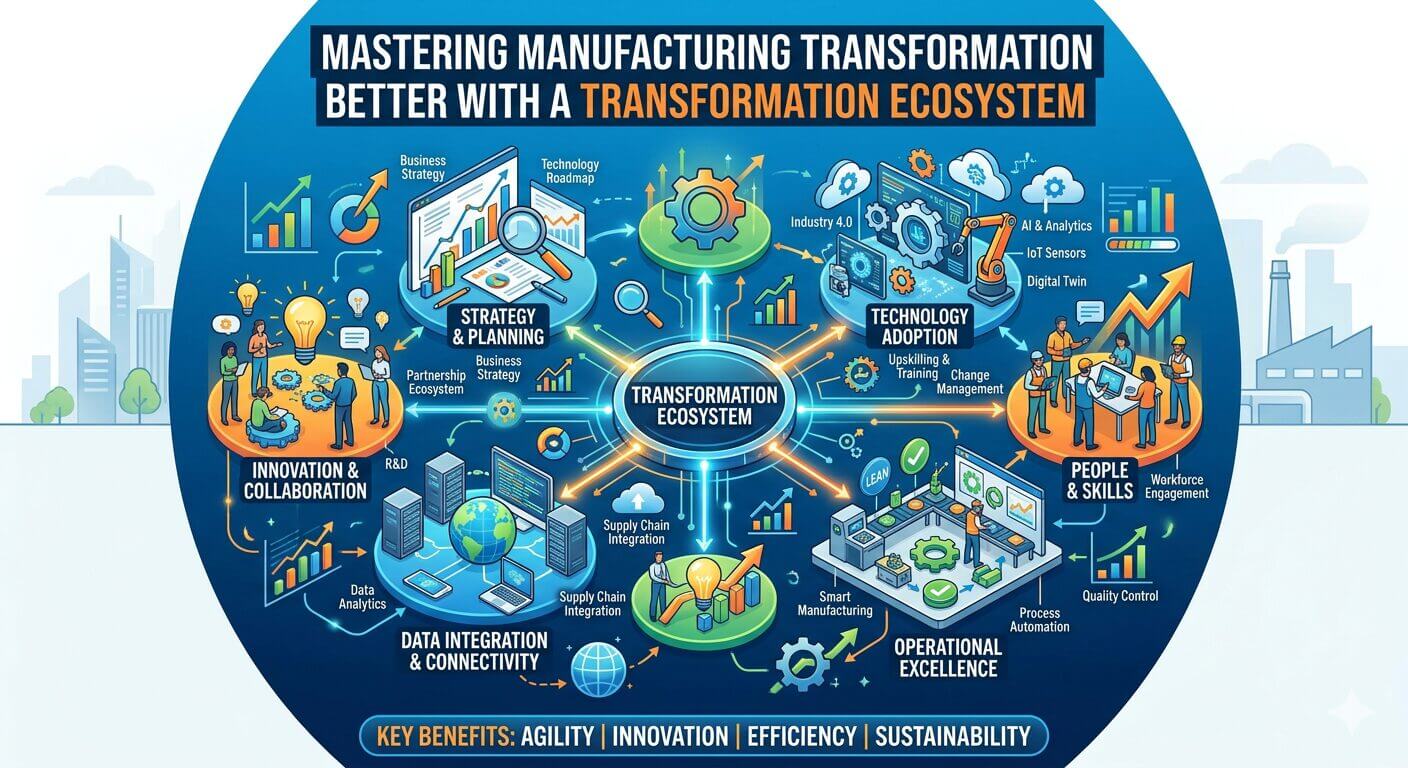
Manufacturing is currently navigating a “perfect storm” of disruption. From shifting global supply chains and labor shortages to the urgent demands of sustainability and decarbonization, the pressure to transform is relentless. Yet, despite record investments in Industry 4.0, a staggering number of projects remain stuck in “pilot purgatory”—small-scale tests that fail to scale or deliver measurable financial impact.
The difference between a failed experiment and a successful transformation lies in the ecosystem approach. To move the needle, manufacturers must bridge the gap between strategic intent and technical execution. This requires a three-pillar framework: a data-driven Prioritisation Index, a rigorous system for Measuring Impact, and a Matchmaking Marketplace to bridge the technology discovery gap.
The Strategy Gap, Why Most Transformations Fail
Most manufacturers struggle with four fundamental questions:
- Where is my maturity? (A realistic assessment of current digital capabilities).
- What is my next step? (A roadmap based on strategic focus, not just tech trends).
- What was the impact? (Evidence that the investment improved the bottom line).
- Are we competitive? (Benchmarking against global peers).
Without an objective framework, companies often invest in “cool” technology—like AI or robotics—without first addressing the foundational bottlenecks in their processes. This leads to digital silos and wasted capital.
Pillar 1: The INCIT Prioritisation Index – Precision over Guesswork
The INCIT Prioritisation Index (part of the Smart Industry Readiness Index, or SIRI) is the “North Star” of the transformation ecosystem. Its primary advantage is that it removes subjectivity from the boardroom.
Instead of asking “What technology should we buy?”, the Prioritisation Index asks: “Which area of your business, if digitized, will deliver the highest financial and operational return?”
The Index analyzes a manufacturer across three dimensions:
- Today’s Maturity: Where the facility currently stands in terms of Process, Technology, and Organization.
- The Cost Profile: Where the company spends the most money (e.g., energy, labor, or material waste).
- The Strategic Roadmap: The specific goals for the next 2–5 years.
By weighting these factors, the Index identifies the “High-Impact Dimensions.” This ensures that if a factory has high energy costs but low digital monitoring, the roadmap prioritizes Energy Efficiency over, for example, Advanced Robotics. This targeted investment is the only way to ensure a transformation project is self-funding.
Pillar 2: Measuring the Impact of Change
A transformation without measurement is merely a hobby. One of the greatest values of the INCIT ecosystem is the ability to create a closed-loop system for Impact Measurement.
By establishing a baseline maturity score before a project begins, and re-assessing after implementation, manufacturers gain a transparent view of their progress. This measurement isn’t just about “going digital”; it’s about correlating digital maturity with Enterprise Key Performance Indicators (EKPIs) like OEE (Overall Equipment Effectiveness), reduced lead times, and lower CO2 emissions.
When a CEO can see that a 2-point jump, in “Vertical Integration” maturity led to a 15% reduction in inventory costs, the transformation gains the internal political and financial momentum it needs to scale globally.
Pillar 3: The Matchmaking Marketplace – Closing the Implementation Gap
The most significant barrier to Industry 4.0 today is the Information Gap. Even when a manufacturer knows what they need to fix (thanks to the Prio Index), they often fall at the final hurdle:
- They don’t know that a specific technology solution exists.
- They don’t know which vendors are reliable or have proven track records in their specific sub-sector.
This is where the Matchmaking Marketplace becomes the “connective tissue” of the ecosystem. By linking the results of a Prioritisation Index assessment directly to a curated marketplace of technology providers, the ecosystem removes the friction of procurement.
The Power of “Prio + Marketplace”
Imagine an assessment that identifies “Predictive Maintenance” as your #1 priority. Instead of spending months researching vendors and sitting through generic sales pitches, the Matchmaking Marketplace presents a list of providers who specialize in your specific machinery and industry.
This transformation ecosystem ensures:
- Speed to Market, reducing the time between “identifying a problem” and “installing a solution.”
- De-risking Investments, working with vetted partners who understand the INCIT/SIRI framework.
- Technological Awareness, surfacing niche innovations (e.g., specialized sensors or edge computing tools) that the manufacturer’s internal IT team might not be aware of.
Conclusion – ECO Systems a Competitive Advantage in a Digital Age
Transformation is no longer an optional “IT project”; it is the core of business strategy. However, the complexity of Industry 4.0 or Industrial AI is too great for any single manufacturer to navigate alone.
By leveraging an ecosystem that combines the INCIT Prioritisation Index for strategy, a rigorous framework for Impact Measurement (EPIK KPI’s), and a Matchmaking Marketplace for execution, companies can stop guessing and start growing. This data-driven approach ensures that every transformation step is a move toward becoming more efficient, more sustainable, and ultimately, more competitive on the global stage.