
Why Industrial Start-Ups Lose Deals They Should Win
When a smart factory analytics start-up closes its seed round, the mood is usually one of hard-won optimism. The product works. The pilots have gone well, and they finally have enough runway to go to market. They begin knocking on doors at manufacturers, armed with case studies. At first the meetings happen, so do the follow-ups but after that, weeks stretch into months. When the reply does come, they tell you it’s not what they expected. Turns out they had just completed a major ERP rollout (AI overhaul) and are still absorbing the disruption.
This is the quiet, grinding frustration that defines industrial B2B sales at the early stage. The product can be right. The customer can be right. The timing can be wrong by a single quarter, and the deal evaporates without either side fully understanding why.
Start-ups burn months of runway chasing opportunities that were never truly open, while manufacturers miss out on solutions that might have meaningfully moved the needle, simply because the conversation happened at the wrong moment in their operational calendar.
The Structural Problem Behind a Familiar Pain
The mismatch isn’t accidental. It reflects a structural gap in how industrial transformation has historically worked. Manufacturers typically move through transformation in non-linear bursts, driven by capital cycles, leadership changes, competitive pressure, or regulatory shifts. A company that was “not ready” in Q1 can become urgently motivated by Q3. But solution providers have no reliable signal for when that shift happens.
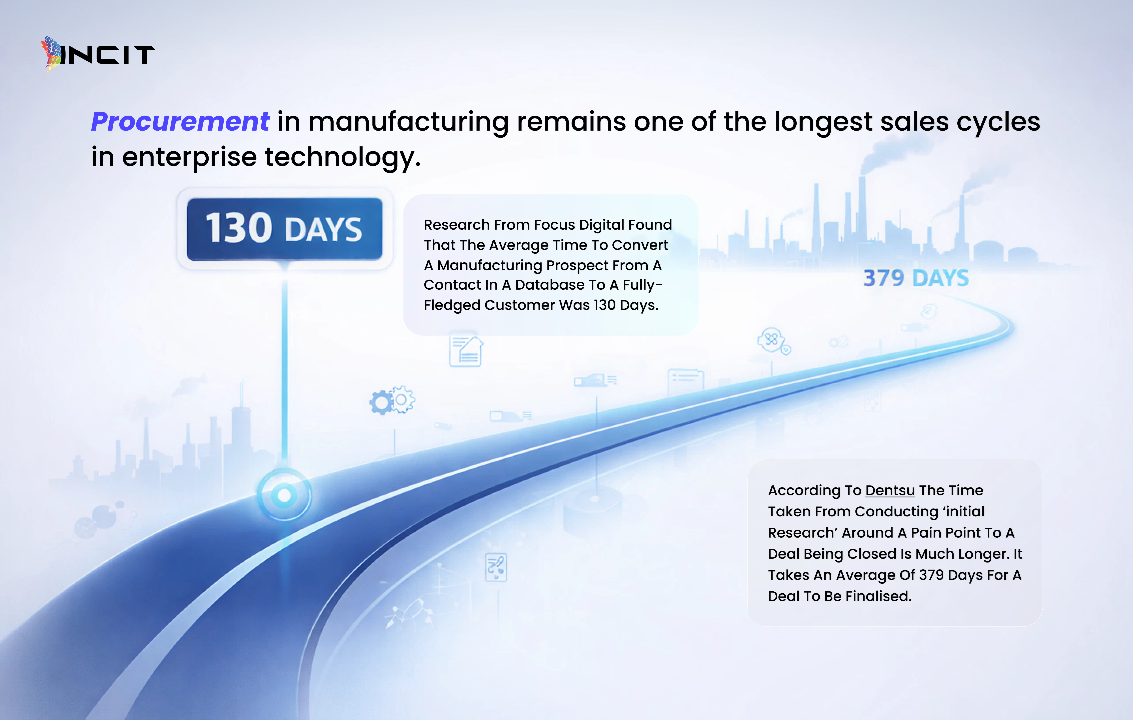
Meanwhile, procurement in manufacturing remains one of the longest sales cycles in enterprise technology. Research from Focus Digital found that the average time to convert a manufacturing prospect from a contact in a database to a fully-fledged customer was 130 days.
But that’s not the whole story, the buying process starts much earlier. According to Dentsu the time taken from conducting ‘initial research’ around a pain point to a deal being closed is much longer. It takes an average of 379 days for a deal to be finalised.
For start-ups without deep balance sheets or established distribution networks, this dynamic is often fatal. The cost of pursuing unqualified leads, in founder time, runway, and morale, routinely exceeds the cost of building the product itself.
What Changes When You Know Where the Client Is
The underlying insight behind Prioritise+ Marketplace is straightforward: matching works better when both sides are assessed against the same framework before they meet.
Prioritise+ operates alongside INCIT’s Prioritisation Index, a structured assessment tool used by manufacturers to map their own transformation gaps across dimensions including operational efficiency, digital technology adoption, supply chain resilience, and workforce capability. Manufacturers arrive at the Prioritise Plus having already identified which parts of their business most urgently need to change.
This creates a fundamentally different starting point for solution providers. Rather than pitching into uncertainty, a provider whose offering maps to supply chain digitalisation, for example, is surfaced specifically to manufacturers who have already identified supply chain as a priority gap. The relevance is established before the first conversation happens.
Two Models for Getting in the Room
Prioritise+ offers solution providers two distinct routes to engaging manufacturers.
InnoSphere functions as a structured marketplace. Providers apply to be listed, with their offerings categorised according to the Prioritisation Index dimensions. Manufacturers searching for solutions in a specific transformation area see relevant providers surfaced against their own assessed priorities. The application is open to any provider with a relevant digital toolkit or solution and uses standard INCIT credentials.
ManuVate takes a more active approach. Rather than waiting to be found, it allows providers to submit tailored proposals to manufacturers with specific, active transformation needs. Currently operating independently at ManuVate.com, with integration into Prioritise Plus underway, ManuVate is designed to be financially risk-free for providers: there is no upfront cost to submit a proposal, and competition happens on the merit and fit of the solution itself.
Together, the two products address different points in the same problem. InnoSphere handles discoverability, while ManuVate handles active pursuit.
The Broader Shift This Represents
Industrial transformation has long been discussed as a manufacturer’s journey. The roadmaps, the assessments, the capability frameworks, all seem to centre on the company that needs to change.
But transformation is never a solo endeavour. Every manufacturer that successfully modernises does so by integrating external expertise, external technology, and external partnerships. The solution provider ecosystem isn’t peripheral to industrial transformation. It is industrial transformation, from the outside in.
The deeper problem has been that this ecosystem has never shared a common language with the manufacturers it serves. Providers pitch in one vocabulary; manufacturers assess their needs in another. Deals fall apart not because the fit isn’t there, but because the two sides never found a common frame of reference.
What Prioritise+ is attempting is to build that shared frame. To give manufacturers and solution providers a way to find each other not just by industry or geography, but by the specific gap that needs to be closed and the specific capability that can close it.
And for the start-up that lost that deal to a six-month timing mismatch, having a better answer to when and why is this manufacturer ready would have been worth more than any feature on the product roadmap.